
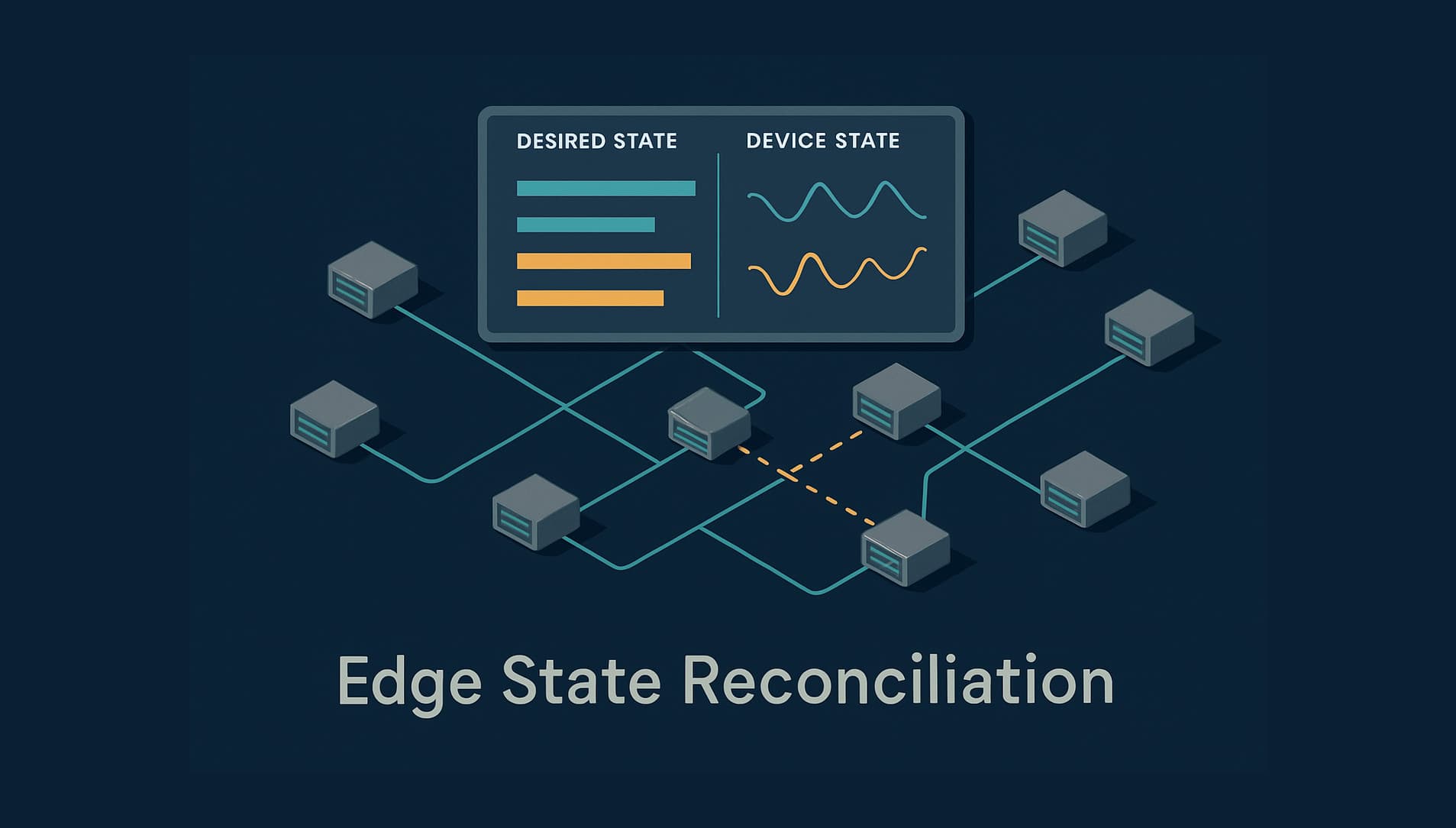
A field router drops off the network halfway through a policy update. The control plane has already accepted the new configuration, but the device only applied two of five changes before power dipped. When it comes back, an engineer has to answer a basic question: what state should win, and how do you converge without making the situation worse? That is the practical setting for edge state reconciliation. In centralized systems, it is tempting to think of change as a single transaction. A request comes in, a database commits it, and the system moves on. Edge fleets do not behave that way. Devices can be offline, underpowered, partitioned, or running work that cannot be interrupted at arbitrary moments. Any platform meant to coordinate software, policies, and operational intent across edge locations has to assume partial progress, stale knowledge, and competing versions of reality. The design intent behind edge state reconciliation is to treat the control plane's desired state and the device's observed state as separate facts that must be compared over time. The goal is not to assume that a command succeeded because it was sent. The goal is to continuously determine what the device should be doing, what it reports it is doing, and what steps are safe to take next. That sounds simple, but it changes how updates, rollbacks, alerts, and operator expectations should be designed. A useful mental model is that each device has at least three states. There is intended state, which comes from an operator or policy. There is applied state, which is what the agent believes it has configured locally. And there is effective state, which is what the workload and surrounding system are actually doing. Those can diverge. A certificate may be present but not yet loaded by a process. A container image may be downloaded but not started. A firewall rule may be written yet superseded by another local rule. A platform is meant to notice these gaps instead of flattening them into a binary success or failure. This is where versioning matters. If a device checks in after several missed intervals, the platform should not blindly replay every command in sequence. In many cases, the better design is to compare the latest desired state with the latest observed state and calculate the minimum corrective action. That approach reduces duplicate work and limits damage from retries. It also makes operations more understandable, because the conversation becomes about convergence toward a declared outcome rather than an opaque history of remote procedure calls. Consider a hypothetical fleet of 1,200 retail edge nodes spread across urban stores, rural kiosks, and pop-up locations. Hypothetical is important here because the engineering question exists regardless of scale. Some nodes have stable fiber links. Others rely on cellular backhaul with brief outages every day. The fleet receives a new networking policy, a logging configuration, and a certificate rotation window. If each update is modeled as a one-shot command, the system will produce uncertainty almost immediately. Which nodes missed the update? Which retried safely? Which are now split between old and new trust bundles? A reconciliation model is meant to make those answers explicit. One design choice is how often reconciliation runs. A tight loop gives faster convergence but creates more overhead on constrained devices and noisy networks. A slower loop reduces traffic but extends the time a device may remain in drift. The right interval depends on the resource being managed. Network policy may justify quicker checks than a large package download. Certificate expiration may need deadline-aware behavior. The platform is meant to support different reconciliation cadences because not every class of state has the same operational risk. Another decision is whether reconciliation is purely pull-based, purely push-based, or hybrid. Pull is resilient because the device can ask for its latest desired state whenever it reconnects. Push can reduce latency when connections are healthy. Hybrid often fits edge conditions better: the control plane records intent immediately, attempts notification when possible, and still relies on periodic agent pull to guarantee eventual convergence. The goal is not to pick one transport pattern as universally best. The goal is to avoid making correctness depend on ideal connectivity. Drift detection also needs careful boundaries. Some drift is harmful and should be corrected automatically. Some drift is expected because a local operator changed a setting to keep a site alive. Some drift is informative, revealing that the desired model does not match real conditions at the edge. A platform is meant to preserve that distinction. If every difference triggers forced overwrite, the system can become brittle. If every difference is tolerated, the control plane becomes advisory rather than authoritative. Good reconciliation design turns drift into categories with different responses, not a single alarm state. Safety depends on idempotency. If the same desired state is evaluated multiple times, applying it again should not corrupt the device. This matters for package installation, service restarts, certificate handling, and storage migrations. The more an operation can be represented as bring this resource to state X instead of run command Y, the easier it is to retry. That is one reason declarative models tend to fit edge state reconciliation better than imperative workflows, even when the underlying implementation still performs ordered steps. Observability has to follow the same logic. Engineers need to see more than whether a job was dispatched. They need to know which version of intent each node has acknowledged, which resources are in drift, what retries are pending, and whether local preconditions are blocking progress. The platform is meant to expose convergence as a timeline rather than a single event. That supports incident response because teams can distinguish a slow rollout from a stuck one and a communications gap from an apply failure. There is also a human factor. Reconciliation changes how operators think about control. Instead of asking, did my command run, they ask, has the fleet converged to the intended state, and if not, why not? That shift usually leads to better operational models at the edge because it matches the realities of intermittent systems. It also encourages safer automation, since rollouts can be guarded by observed state checks instead of simple dispatch completion. For MeteorCloud, this engineering angle suggests a platform model where desired state, observed state, and convergence logic are first-class concepts rather than implementation details. The goal is to support edge management that remains understandable when devices are late, offline, or only partly updated. The platform is meant to help engineers reason about drift, retries, and eventual consistency without assuming perfect links or perfectly obedient nodes. An engineer evaluating this approach should decide which resources in their fleet can be managed declaratively, what kinds of drift should auto-correct, how much reconciliation latency is acceptable, and where human review should interrupt convergence.